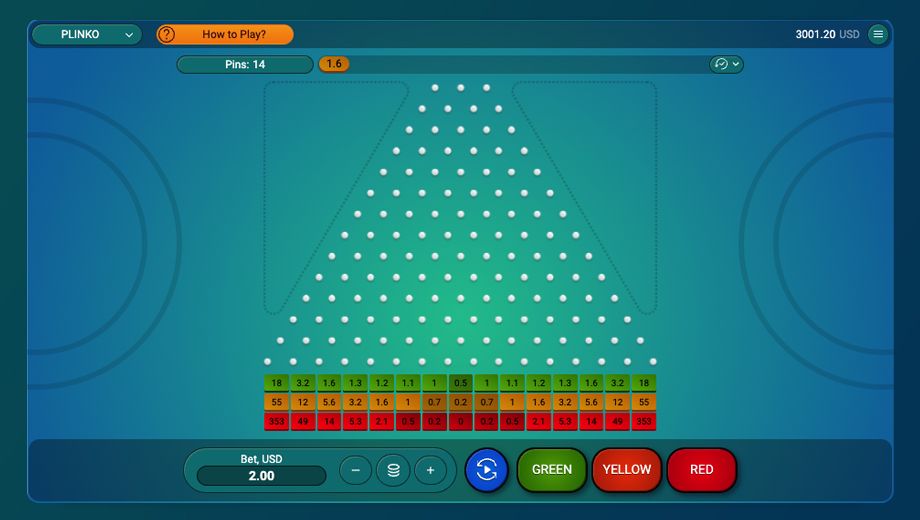
Spribe Plinko is a 97% RTP arcade ball-drop game: you choose a disc colour and the number of pins, release the disc and watch it bounce down the peg board into a multiplier pocket. The format is deliberately simple, but three settings decide the experience — the board size (12, 14 or 16 pins), the disc colour (Green, Yellow or Red, which act as risk levels) and your stake. We rate the visible payout strips and bounded autoplay controls as its useful features; the 3% house edge and the withdrawal risks of offshore casinos are the reasons to keep any trial to virtual credits.
Spribe Plinko Review: Key Facts
Plinko adapts the American game-show pegboard format for online play. It is a mini game rather than a slot: there are no reels, no free spins and no bonus rounds. What you see is a board, a payout table and a stake, so the two numbers that matter most are the RTP and the maximum multiplier.
| Specification | Spribe Plinko |
|---|---|
| Developer | SPRIBE |
| Game type | Mini game (arcade ball drop) |
| Theoretical RTP | 97% (3% house edge) |
| Rows / pins | 12, 14 or 16, adjustable in the game client |
| Risk levels | Green (low), Yellow (medium) and Red (high) discs |
| Maximum multiplier | 555x (16 rows, Red disc, edge pocket) |
| Bet range | Check the currency and limits displayed beside the stake; the supplier screenshots use USD, not AUD |
| Devices | Desktop, tablet and mobile (HTML5, no download) |
| Extra features | Autoplay, Rain promo, free bets, in-game chat |
The trade-off for that simplicity is that everything comes down to the payout table: the disc has no skill element once it is released, and no staking pattern changes the stated RTP.
How Spribe Plinko Works: Pins, Discs and Controls
A disc falls from the top of the board, deflects off pegs and lands on a multiplier at the bottom. Before each drop you set the stake, choose how many pins the board uses and pick a disc colour. Pressing one of the three coloured buttons releases the matching disc.
The pin count is the main control over how results spread out. With 12 pins the disc makes fewer left/right deflections, so it lands nearer the middle more often; with 16 pins the distribution stretches wider, so edge pockets become rarer and their multipliers larger. The selector labelled “Pins” sits above the board; the available layouts are 12, 14 and 16 rows.
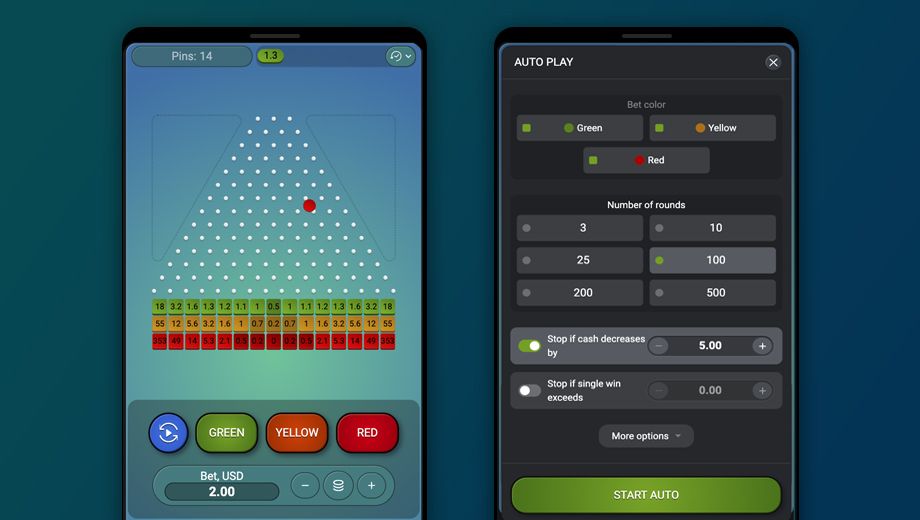
The blue circular-arrows button beside the stake opens Auto Play. SPRIBE’s desktop screenshot shows colour checkboxes, round counts of 3, 10, 25, 100, 200 and 500, and two separate switches: “Stop if cash decreases by” and “Stop if single win exceeds”. Entering an amount with its switch off does not enable that condition. The mobile screenshot shows a 5.00 cash-decrease threshold switched on and a separate “START AUTO” button.
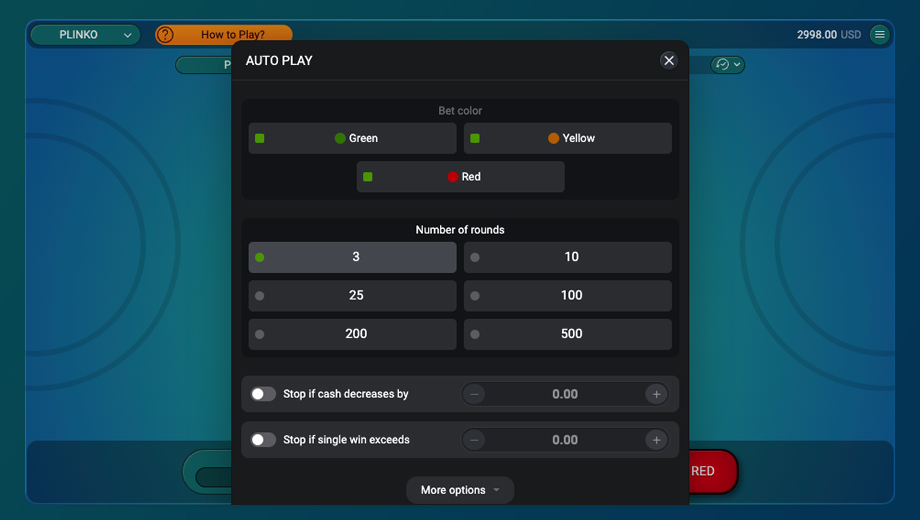
For a demo trial, leave the stake fixed and start with the shortest batch and one colour. With AUD 0.10 as a hypothetical stake, 100 drops stake AUD 10 in total; the expected loss at a 3% house edge is AUD 0.30, while the actual loss can be much larger. A cash-decrease threshold watches the balance, whereas the round count limits activity even if wins temporarily refill it.
For a comparison with Spribe’s crash game, see our Plinko vs Aviator guide, including equal-turnover costs and two-panel payout examples.
Spribe Plinko RTP and House Edge
SPRIBE lists Plinko’s theoretical RTP as 97%, which corresponds to a 3% house edge over the long run. The figure is fixed for the game rather than varying by operator or by which coloured button you press; the risk settings change the variance, not the average return. As always, 97% is a long-run average — it does not mean you get 97% of your stake back in any single round or session.
Because the RTP is identical across risk levels, choosing Red does not change your expected return — it changes how that return is delivered. Low-risk Green discs pay small, frequent multipliers near the centre; high-risk Red discs concentrate losses in the central pockets and pay large multipliers occasionally at the edges. Our RTP and volatility comparison explains how that trade-off works across Plinko titles.
Green, Yellow and Red: Risk Levels and Multipliers
The three disc colours are the risk selector. Green is the low-volatility option, Yellow sits in the middle and Red is the high-volatility option with the largest potential multipliers and the highest chance of a near-zero return. The colour does not change the 97% RTP; it changes the shape of the payout curve.
Each colour has its own multiplier table, and the edge multipliers grow with the pin count. Yellow sits between the two extremes, with mid-range multipliers and a moderate chance of a small loss. On the supplier’s 14-row screenshot, Green ranges from 0.5x to 18x, Yellow from 0.2x to 55x, and Red from 0x to 353x. All three payout strips are visible together. A multiplier is the total return: on a hypothetical AUD 1 drop, 0.5x returns AUD 0.50 (a 50-cent loss), 1x breaks even and 0x loses the full stake. Our explorer uses that photographed 14-row table to calculate pocket probabilities and net returns; its simulation is an educational model, not the SPRIBE demo.
Spribe Plinko Max Payout: 555x on 16 Rows
The highest multiplier in Spribe Plinko is 555x, paid by the edge pocket on a 16-pin board with the Red (high-risk) disc. Under an equal-probability, independent left/right model, reaching one edge requires 16 deflections in the same direction: 1 in 65,536 for a particular edge, or 1 in 32,768 for either edge. These are model probabilities, not measured frequencies from a test session. The Red edge multiplier scales with the board, so the top payout is only reachable on the largest, highest-risk setting.
The verified 14-row Red strip has a 0x centre, flanked by 0.2x pockets. In the same binomial model, the centre alone accounts for 3,432 of 16,384 paths (20.95%); those three central pockets together account for 57.60%. This explains why a small return and a complete loss must be distinguished when comparing colours.
Playing Spribe Plinko in Australia: AUD Deposits and Legality
Providing online casino gambling to people in Australia is prohibited under the Interactive Gambling Act 2001. A casino accepting AUD or Australian registrations does not gain permission to offer it. ACMA warns that Australian regulators cannot help recover winnings withheld by an illegal operator, and access may be blocked. Our Interactive Gambling Act overview explains the distinction between licensed wagering and online casino games.
SPRIBE supplies the game; the casino controls deposits, identity checks and withdrawals. A USD balance in a demo says nothing about an operator’s AUD cashier. Before committing money to any service, inspect its account currency, conversion charges, withdrawal fees, identity documents and bonus restrictions. We do not list recommended Australian Plinko casinos because payment access cannot resolve the legal and recovery risks.
In-Game Features: Rain Promo, Free Bets and Mobile Play
Rain and Free Bets are operator promotion tools. Their presence in the game catalogue does not entitle a player to a particular offer.
Rain Promo and live chat
Rain adds claimable free bets to the chat at random times. Tap “claim” when an offer appears, then read its expiry and wagering conditions before using it. The promotion does not change the underlying payout table.
Free Bets terms
For a free-bet offer, check whether the original free stake is returned with a win, which colours and rows qualify, and whether winnings have a cash-out cap. An offer with unclear terms is a reason to leave it unused; demo credits are not a withdrawable bonus.
Mobile portrait controls
The supplier’s portrait image puts “Pins” at the top, three compact payout strips beneath the board, and the colour buttons above the stake. Auto Play occupies a separate panel with its start button at the bottom. The multiplier labels are compact: enlarge them before comparing colours, then return to the controls to select the stake. We have not measured loading speed or mobile data consumption.
Verifying Drops: Provably Fair in Spribe Plinko
SPRIBE’s verification instructions distinguish two hashes: SHA-256 commits to the server seed before a round, while SHA-512 hashes the combined server and client seeds used to generate the result. A Stake-style HMAC-SHA256 verifier is therefore unsuitable. The client seed is editable through the user menu’s “Provably Fair Settings”; the commitment is labelled “Next server seed SHA256”.
- Before a demo drop, copy the next server-seed SHA-256 commitment and your client seed. Keep them with the chosen row count, colour and stake.
- Release one disc. Record the round ID and multiplier in game history, then open that round’s provably fair icon.
- Copy the revealed server seed, client seed or seeds, combined hash and result. Check that the saved client seed matches the completed round.
- Hash the revealed server-seed text with SHA-256 and compare all 64 hexadecimal characters with the commitment saved before play. For a local text check, use
printf '%s' 'REVEALED_SEED' | openssl dgst -sha256, replacing the placeholder with the exact seed. Preserve case and whitespace in the seed; avoid an extra newline. A mismatch fails the commitment check. - Use the round panel’s seed ordering and concatenation to recompute SHA-512; compare all 128 hexadecimal characters. The provider’s published teaching example combines server seed
ABand player seedCDintoABCD, whose SHA-512 starts49ec55bd83fcd678. Those are demonstration strings, not captured Plinko seeds. - Finally, check the result against the game-specific mapping and the payout strip for that colour and row count. Matching hashes verify the inputs; they do not by themselves establish the landing pocket or payment.
Our access check reached the official demo launcher, but its main client script returned HTTP 403. We therefore have no played round, captured seeds or current Plinko fairness-panel screenshot to publish. The control descriptions above use SPRIBE’s own images; the verification sequence follows its published instructions. Our provably fair guide explains commitment checks and their limits. If a round cannot expose the values needed for a check, leave its verification unresolved rather than treating the badge as proof.
Our Auto Bet settings and AUD cost guide explains the difference between a cash-decrease stop and a single-win threshold, including why settlement can pass a loss limit.
Bankroll Rules and Auto-Play Pitfalls
The 97% RTP is a theoretical long-run figure, not a guarantee for an individual session. No staking approach changes the game’s stated RTP or guarantees protection from losses. Consider setting a budget and stopping if play is no longer enjoyable:
- Set a budget: Choose an amount you can afford to lose and do not treat a particular colour or pin setting as a reliable way to protect your balance. See our bankroll management strategies for general budgeting guidance.
- Try the demo: Open “Play Demo” from SPRIBE’s product listing, then read the free Plinko demo guide for how demos differ from real-money play.
- Watch the autoplay count: Autoplay can run far more drops than you would place by hand. Set the number of drops to match your budget, not your balance.
Gambling Help Online provides free, confidential counselling across Australia, 24/7, on 1800 858 858. BetStop covers licensed Australian online and phone wagering providers; it does not block unlicensed offshore casinos.
Before Starting a Demo
Open the game rules first and compare the displayed payout strip with the selected colour and rows. Make one manual drop, locate its history entry and attempt the fairness check before enabling autoplay. Set both the batch length and an active cash-decrease threshold; stop the trial if you cannot tell which stake or conditions are in force.