There is no Australian-licensed online casino Plinko service to recommend for a $5 or $10 AUD deposit. The Interactive Gambling Act 2001 prohibits providers from offering online casino services to people in Australia. A free demo lets you learn the game with a $0 deposit and no money at stake.
What a deposit minimum actually tells you
The cashier’s minimum deposit is the smallest top-up accepted through the selected payment method. The game’s minimum bet is a separate setting: it determines how much one ball costs. A $5 deposit claim leaves the stake per drop, fees and amount needed to withdraw unresolved.
Offers also need to be checked in context. A site may show a low minimum on a promotional page while its cashier, payment provider or terms set a different amount. Deposit and withdrawal conditions can vary by method and account, so do not assume that an advertised AUD figure applies to every player or transaction. For a beginner-friendly explanation of the game’s rules and payout pockets, see how Plinko works.
For supplier evidence and the cost of one ball, see our Plinko minimum bet guide, including ten-cent AUD examples and the difference between a selected stake and a verified floor.
How $5 and $10 compare at different stakes
For a hypothetical AUD balance, divide the budget by the stake per ball. The figures count full stakes before any returns are reused; actual session length changes with the results.
| Stake per ball | $5 budget | $10 budget |
|---|---|---|
| $0.10 | 50 stakes | 100 stakes |
| $0.50 | 10 stakes | 20 stakes |
| $1 | 5 stakes | 10 stakes |
A pocket multiplier applies to the stake. At $0.10 per ball, a 0.7× result returns $0.07, leaving a $0.03 loss; 1.3× returns $0.13, a $0.03 profit. Seeing a payout animation can therefore still mean losing money on that drop.
When a small balance gets stuck
Read the withdrawal minimum separately from the deposit minimum, for the method you would use to receive funds. In an illustrative case with a $20 withdrawal minimum and a $15 remaining balance, the ordinary withdrawal threshold is still unmet. We would ask in writing about closing the account and returning unused funds, because paying another $5 creates further exposure without settling the original withdrawal problem. Any refund depends on the applicable terms and circumstances.
Check whether the stated minimum is in AUD, whether fees are deducted from the payment or added on top, and whether currency conversion reduces the credited balance. A fixed $1 fee would consume 20% of a $5 payment or 10% of a $10 payment.
A bonus can require much more than the deposit
The cashier minimum and the bonus-qualifying deposit may differ. For example, a hypothetical $20 qualifying threshold would leave a $10 deposit ineligible. Before accepting an offer, check that Plinko is eligible, its wagering contribution, the expiry time, maximum permitted bet and any cap on cashing out bonus winnings.
For a hypothetical $10 deposit with a $10 matching bonus, 35× wagering on the bonus alone means $350 in eligible bets. If 35× applies to deposit plus bonus, it means $700. At a hypothetical 10% game contribution, clearing the first requirement would take $3,500 in actual stakes. Our bonus wagering guide explains how to read the calculation basis before mistaking a larger displayed balance for withdrawable cash.
The Australian legal context
These rules target the supply and advertising of the service to people in Australia. Australia’s rules distinguish between online casino services and other gambling products. ACMA lists online casino-style games, including slots, poker and roulette, among prohibited online casino services offered to customers in Australia. The regulator also says prohibited online gambling services must not be advertised here.
That advertising rule is relevant when a page ranks offshore casinos, publishes reviews with direct operator links or earns commission for referrals. ACMA identifies affiliate promotions of prohibited online gambling—including casino reviews linked to operators for commission—as conduct that may contravene the advertising prohibition.
ACMA records complaints from customers whose deposits were accepted but winnings were withheld, whose balances disappeared when an operator closed or moved, and whose bank accounts continued to be debited after they stopped using the service. These reported experiences explain why a small successful deposit is a poor test of whether you will get money back.
ACMA’s register of licensed interactive gambling providers is a register for wagering providers; it is not a list of legal online casinos. For a wagering operator, compare the trading name, licence holder, website address and licensing authority. The entry covers its wagering service.
PayID, POLi and crypto claims
Scamwatch warns that gambling scams can involve requests for repeated small payments to different accounts or PayIDs. If a payment instruction changes, a site asks you to send extra funds to unlock a withdrawal, or the recipient details keep changing, stop and do not send another payment.
POLi is another claim to treat carefully. POLi’s Australian service ceased operating on 30 September 2023, while its New Zealand service continued. A casino guide still presenting POLi as an Australian deposit option has outdated payment information. POLi’s service notice confirms the closure.
From 11 June 2024, Australian online and telephone wagering operators have been prohibited from accepting credit cards, credit-linked funds—including digital wallets—and digital currency such as cryptocurrency for bets. The ban concerns wagering; lotteries are outside its scope. Our crypto payment guide covers network and conversion costs when assessing an AUD-equivalent claim.
How to check a low-deposit claim
- Start with the service: Identify the operator and product, then consult ACMA’s Australian rules. Read our Interactive Gambling Act overview if a promotion blurs online casinos and licensed wagering.
- Compare the documents: Save the promotion and current terms. Look for the deposit method and currency, stake per ball, withdrawal threshold, fees and any bonus conditions described above.
- Protect your identity: Scamwatch advises withholding identity documents unless you are certain you are dealing with a regulated business in Australia. A request for a passport can be part of the scam.
If you have already paid and cannot withdraw
Contact your bank or card provider immediately using its usual app or published contact number, report the suspected scam and ask it to stop further transactions. Keep receipts, transaction references, the website address, screenshots of the balance and withdrawal messages, and any chat history. Recovery is uncertain; ACMA warns that Australian regulators cannot recover withheld winnings from illegal operators.
Report the suspected scam to Scamwatch and the illegal gambling service to ACMA through the complaint routes in their guidance. If you shared identity documents, IDCARE offers free help with limiting identity misuse on 1800 595 160. Change compromised passwords, especially for banking and email.
Try the game without depositing
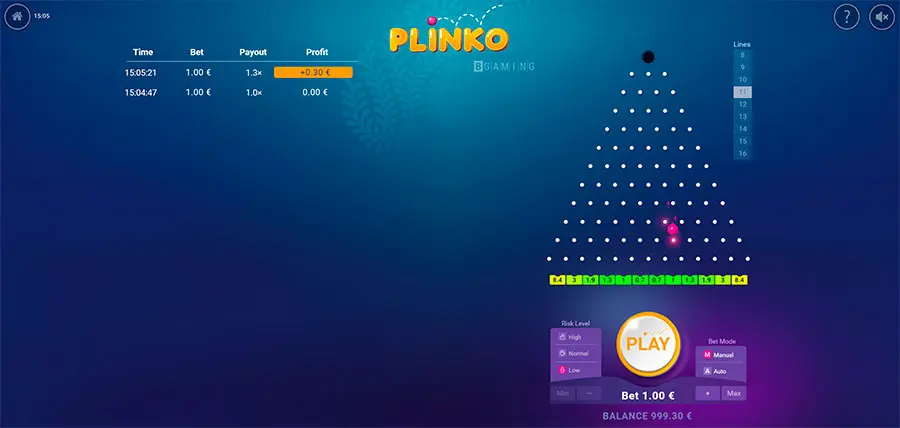
If your aim is to understand Plinko before risking money, a free demo is a more suitable starting point than searching for the smallest real-money deposit. In the standard format, a ball falls through offset rows of pegs and lands in a bottom pocket that determines the payout. The pocket ratios and paytable determine the result; changing the stake does not make a particular pocket more likely.
Game specifications differ by provider and title. BGaming’s Plinko rules describe selectable board lines, Low, Normal or High risk, and Manual or Auto bet modes. Its official page lists a 99% RTP, while Sugar Plinko is listed at 97%; those figures belong to those specific games and are not one universal “Plinko RTP”. For a no-stakes introduction, use the free Plinko demo guide, then review the RTP and volatility comparison to understand what those measures can—and cannot—tell you.
A demo can help you learn the controls, compare risk settings and see how a board behaves over a short session. Its practice credits have no cash value.
A short demo session
- Open BGaming’s official Plinko game page, listed in Sources, and choose Play Demo. Keep the session in the free mode.
- Choose Low risk, 8 lines and Manual. Inspect the displayed stake and currency before pressing Play; a euro symbol or FUN balance should not be read as an AUD cashier amount.
- Drop ten balls individually. For each, compare the stake, multiplier, payout and profit. Keep the settings fixed so the paytable stays comparable.
- Change one setting and inspect the new pocket values. Leave Auto off while learning: BGaming’s rules allow a batch of automatic bets, which can commit multiple stakes quickly.
Keep a firm limit
Plinko outcomes vary, and a run of small returns does not mean a large multiplier is due next. Decide in advance how much time you want to spend and what amount you can afford to lose; do not borrow, chase losses or raise stakes to try to recover a previous result. A bankroll plan can help you set session limits, but it cannot remove the game’s underlying risk. See the Plinko bankroll guide for practical limit-setting principles.
If gambling is causing stress or affecting your finances, free confidential support is available through the Gambling Helpline on 1800 858 858, 24 hours a day, seven days a week. Gambling Help Online also offers free online chat with professional counsellors around the clock. BetStop is a free self-exclusion service for Australian-licensed online and phone wagering services; its scope is not offshore online casinos.