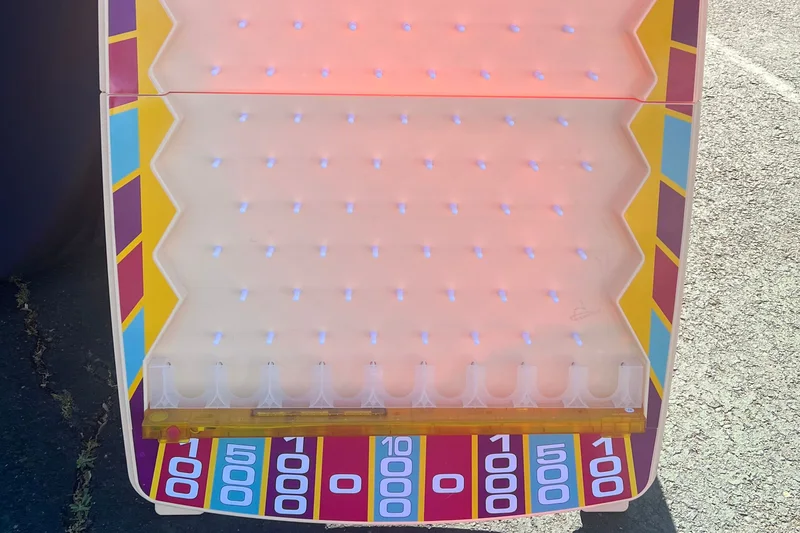
Plinko made its television debut on the US game show The Price Is Right on 3 January 1983. The falling-disc format has an older mathematical relative: Francis Galton’s quincunx, a pegboard used to demonstrate statistical dispersion. Online casino developers later adopted the falling-ball idea for games with stakes, multipliers and their own payout rules. We separate those three histories because recognising the board tells you very little about the odds of a particular game.
A documented Plinko timeline
| Date | Documented milestone | What it establishes |
|---|---|---|
| 1873 | UCL dates its surviving quincunx to this year. Tisley and Spiller made it in London to Galton’s design. | The statistical pegboard existed well before the television game. |
| 3 January 1983 | CBS’s historical caption records Plinko’s debut on The Price Is Right. | A dated starting point for the television game bearing that name. |
| 2019 | BGaming says it introduced its Plinko game in this year. | A confirmed casino adaptation by a named developer, without establishing the first online Plinko anywhere. |
| 8 January 2025 | BGaming announced Plinko 2, adding purchasable features to its falling-ball format. | The online branch had developed its own sequels and mechanics. |
The evidence for each milestone is listed in our sources. We have not assigned a single “online invention” date: a developer’s release establishes the history of its own product. It does not date every browser game, mobile adaptation or earlier digital board.
Before television: Galton’s statistical board
UCL’s collection record identifies Francis Galton as the designer of its quincunx and Tisley and Spiller as its makers. The instrument carries a note describing its purpose as illustrating dispersion. That distinction between designer and maker gives a more precise account than describing Galton as the inventor of the later television game.
In the idealised model, an object meets successive rows of staggered pegs and moves left or right at each row. Different routes can lead to the same finishing position. More routes lead towards the centre than towards either extreme, so repeated drops build a concentration around the middle. The familiar bell-shaped outline describes the accumulated distribution; an individual object still finishes in one particular compartment.
Here is our calculation for a deliberately simplified board: eight independent rows, equal left/right probabilities, one starting point and no walls changing a route. There are 2⁸ = 256 equally likely sequences. The centre can be reached by 8! / (4! × 4!) = 70 of them, giving 70/256 = 27.34375%. The far-left endpoint has just one route, all left, so its probability is 1/256 = 0.390625%; the far-right endpoint has the same probability.
These are calculated probabilities for the stated model. A physical television board can have different starting positions and boundaries; a software game has its own outcome-generation rules. We would not use these numbers to price a television chip or claim the odds of an unidentified app. Our guide to Plinko mechanics develops the row-count model and explains where animation and outcome generation differ.
What The Price Is Right added
The television format gives the board a pricing-game structure. The show’s official game description says contestants identify correct digits in the prices of small prizes to earn chips. They then release the chips individually from the top of a physical board into money slots below. The description lists up to US$10,000 per chip. That is the amount on the official description checked for this page, rather than a claim about the board at its debut or every special episode.
This creates two different tasks for a contestant: judging a product price to obtain a chip, then releasing the chip and watching where it lands. A casino version can retain the descending object while removing the product-pricing task entirely. Knowing supermarket prices therefore has no role in the multiplier calculation of that casino game.
The television prize above is denominated in US dollars. Our casino calculation below uses a hypothetical AUD stake.
| Feature | Television game | Casino example: BGaming Plinko 2 |
|---|---|---|
| Entry to a drop | Chips earned through the small-prize pricing task described by the show. | A configured game round with a stake and optional purchasable features. |
| Result shown | A money amount in a slot. | A multiplier applied under the game’s rules. |
| Configuration | A physical game board. | Eight to sixteen active lines and low, normal or high risk, according to its release announcement. |
| Financial interpretation | A television prize. | A return on a wager, which must be compared with the amount paid. |
From the screen to casino adaptations
BGaming’s Plinko 2 announcement looks back to the studio’s original Plinko release in 2019. For the sequel, it describes extra multiplier lines, multiplier balls and a respin feature. The developer calls these purchasable bonuses and states a 99% RTP. Those additions show how far a casino adaptation can depart from the simple television drop, even while retaining a recognisable pegboard.
For a reader moving between versions, the sequel creates a new question: is the price shown for the basic drop or for a drop with extra features? Record the selected features alongside the stake when comparing two rounds. The base multiplier alone cannot describe a round’s cost.
The financial change is easiest to see with a hypothetical AUD example. Suppose a digital game accepts a $2 AUD stake and its rules define the displayed multiplier as the total return. A 0.5× result returns $1 AUD, leaving a $1 AUD net loss. A 10× result returns $20 AUD, leaving an $18 AUD net gain. Extra feature charges would also need to be deducted. A chip landing beside a cash label on television does not teach that accounting.
For a specific implementation, read our BGaming Plinko review. To compare different titles, use the RTP and volatility comparison; a shared name does not establish a shared paytable.
Identify the version before using its rules
We recommend recording the developer and exact game title first, because a guide to a different release can give you the wrong settings or payout assumptions. Then make these checks:
- Read the payout definition. Establish whether a multiplier includes the original stake and whether an optional feature adds a separate charge. Calculate the net result from the full cost of the round.
- Check how the outcome is generated. A bouncing animation alone cannot demonstrate either physical simulation or cryptographic verification. If the game supplies a verification process, use the relevant algorithm and round data; our provably fair guide explains the evidence to look for.
- Separate a demonstration from a cash account. Our free Plinko simulator uses virtual credits to illustrate a board. It is an educational model, with no cash withdrawal and no claim to reproduce the television apparatus.
For readers in Australia, the game’s television ancestry does not authorise an online casino service. ACMA identifies online casino-style services among the services prohibited from being provided or advertised to people in Australia under the Interactive Gambling Act 2001. Our Australian legal guide explains the service restrictions. Start with a virtual-credit demonstration if your aim is to understand the board, then consult the rules of the exact version you are researching.