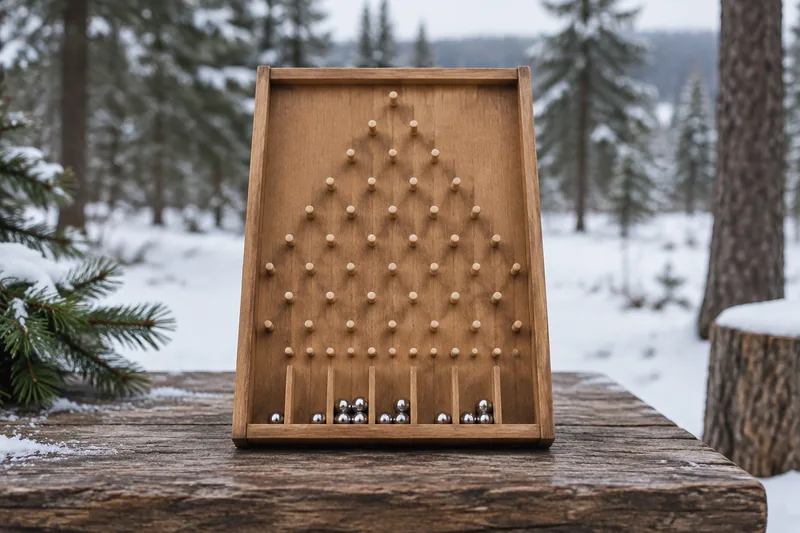
Pine of Plinko is a 5-reel, 3-row video slot from Print Studios, a Malta-based studio founded in 2020 and distributed through Relax Gaming's Silver Bullet programme, and its one substantial feature is a Plinko bonus round. The maximum win is 10,000x for the original and 20,000x for Pine of Plinko 2, where a single Golden Ball drop in the bonus can pay up to 10,000x on its own.
Both games have a volatility rating of 4 out of 5. The sequel’s 20,000x maximum has a theoretical probability of 1 in 28 million spins. For Australian readers, online casino services are prohibited under the Interactive Gambling Act 2001.
What changed between the two games
The original launched as Pine of Plinko Dream Drop, with a network progressive jackpot. A later non-jackpot edition retained its reels and bonus board. The base game has five reels, three rows and ten paylines, with most of the feature mechanics reserved for the Plinko bonus. The Dream Drop edition has a theoretical bonus frequency of 1 in 126 spins, or 1 in 60 with Scatter Boost.
The original offers Scatter Boost. It costs 75% on top of the base bet. In the non-jackpot edition, Scatter Boost has 96.78% RTP; a 79x bonus buy has 96.94% RTP where that feature is available.
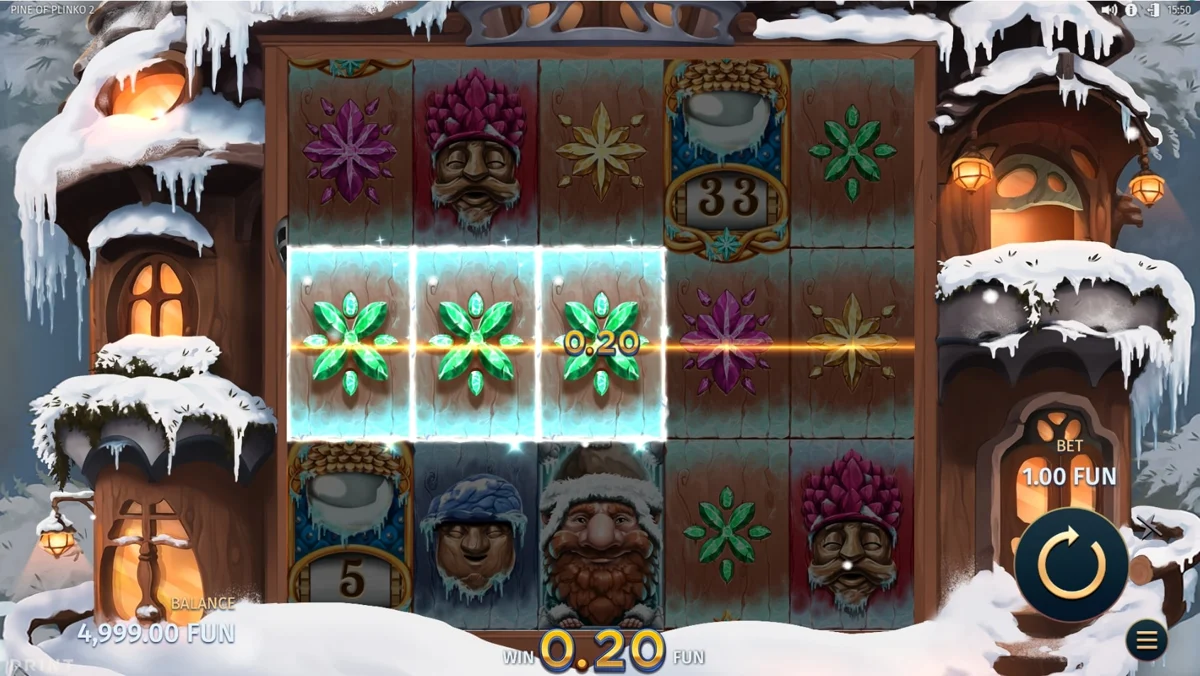
The sequel keeps the same 5x3, 10-line frame and adds layers to the bonus rather than to the base game. Its base RTP is 96.32%, rising to 96.42% with Scatter Boost and 96.50% with the bonus buy. The advertised stake limits are €0.10 to €50, not AUD limits. Line wins require at least three matching symbols on adjacent reels, beginning on the leftmost reel; scatters count anywhere. The sequel also has no wild symbols.
| Release | Date | How it fits the series |
|---|---|---|
| Pine of Plinko Dream Drop | 31 January 2023 | Original board plus a separate jackpot round: unlimited drops fill five jackpot meters, with the first full meter deciding the jackpot tier. |
| Pine of Plinko 2 | 7 December 2023 | Winter sequel; the separate progressive jackpot round is absent. |
| Pond of Plinko | 10 December 2024 | Later series entry: 30,000x cap; 96.10% to 96.49% base RTP and 96.27% to 96.67% with bonus buy. |
Pond of Plinko sits alongside the two Pine titles in the same series, with a 10 out of 10 volatility rating and a base-game feature that can pay up to 10,000x.
Inside the bonus board
The board, prize pockets and payout structure are fixed. You choose when to release the next drop, without selecting a row count or risk level. A drop is one press of the button; later stages release several balls with that same press.
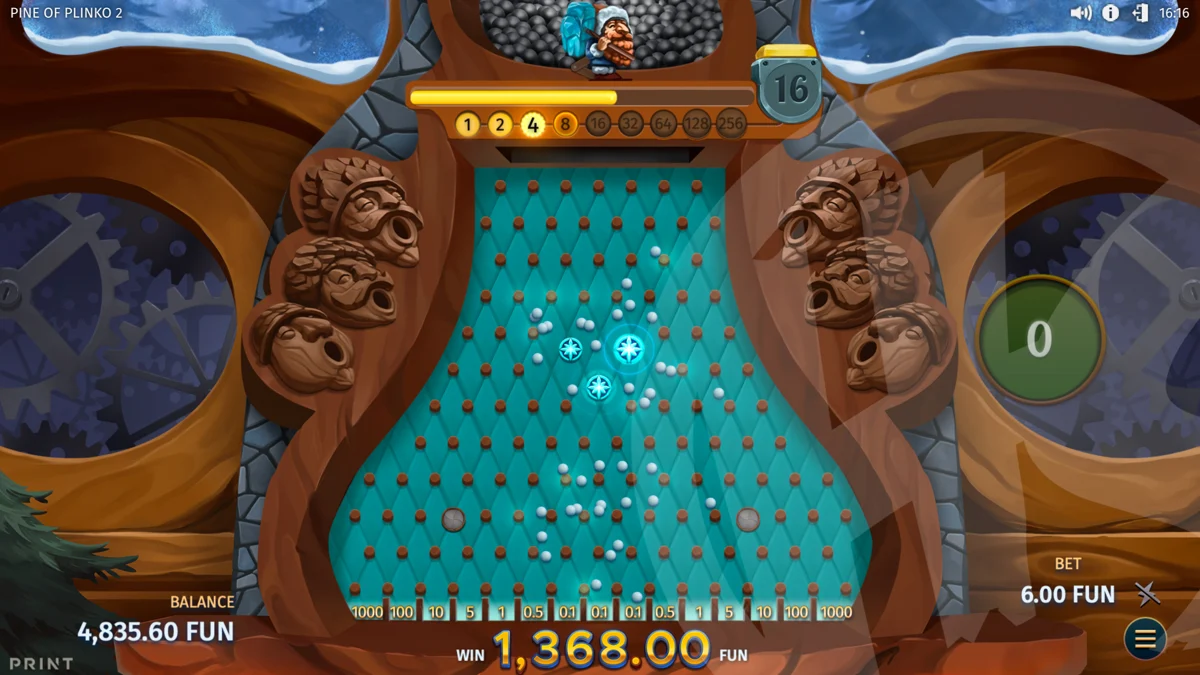
- Scatters set the drop count. Three or more scatters open the bonus, and each one carries a value of up to 99. The values are summed to give your starting drops. Five scatters showing 99 would supply 495 starting drops; three showing 99 would supply 297.
- Bumpers advance the stage. Balls that hit the three bumpers in the upper middle of the grid fill a meter. Filling the meter awards entry to the next stage. It begins after the current stage’s drops are used, adds 10 drops and doubles the number of balls released with each press.
- Ball counts snowball. The progression is 1, 2, 4, 8, 16, 32, 64, 128 and 256 balls per drop across the stages. At the final stage, ten drops release 2,560 balls.
- Pockets decide the win. Balls land in one of 15 gaps at the bottom, with prize values from 0.1x to 1,000x. The values accumulate until the bonus ends.
Pine of Plinko 2 changes the board itself. Bumper Buckets are prize buckets that can shift into catapults, throwing balls back to the top so they can hit the bumpers again and take another shot at a 1,000x pocket. Special hatches can also open at the start of a stage, and a ball caught in one of those sends you to the Golden Ball round, where a single drop can pay up to 10,000x.
The sequel adds a scatter re-roll as well. If the third scatter lands on a low value, you can pay a fee to re-roll it and chase a bigger starting drop count. Each eligible scatter displays its own price. Paying for a re-roll does not guarantee an increase. The option disappears for a scatter whose value is already too high.
A Golden Pocket catch awards a Golden Ball Drop at the end of the current stage. That drop uses a separate prize board without bumpers; afterwards the ordinary Plinko Bonus resumes. The Bumper Buckets instead recycle a ball on the current board and can bounce the same ball back more than once.
Pine of Plinko uses slot RNG outcomes. There is no player-facing server seed, client seed and nonce checker. A binomial calculation for a symmetrical single-ball board cannot establish the odds of its bumpers, catapults or stage progression.
What the win limit covers
The sequel’s 20,000x limit applies to the complete game round. If accumulated wins reach that limit, the round ends and the capped amount is awarded. A Golden Ball award contributes to that total; it is not an extra payment above the cap. The Dream Drop edition’s 10,000x limit covers non-jackpot game wins, with the network progressive treated separately.
Spin speed and the timing of the Drop button do not change the payout probabilities. A bigger stake increases the cash amount of both a loss and a win without making a Golden Pocket more likely to open.
If you want to understand how those caps compare with the arcade titles most Australian players already know, the series sits in a different category: Stake's Plinko original and BGaming's Plinko list 99% RTP and a 1,000x ceiling, with smaller maximum outcomes. Their payout distributions depend on the selected risk setting, so the maximum multiplier alone does not rank their volatility. The RTP and volatility comparison sets out where each game sits.
The jackpot version changes the return
The original’s Dream Drop edition has 93.48% total RTP, including a 12-percentage-point jackpot contribution. The non-jackpot edition has 96.48% RTP. With Scatter Boost, the Dream Drop edition returns 93.79%. Removing Dream Drop therefore raises the total return by three percentage points while also redirecting the jackpot allocation into ordinary game payouts. Subtracting the full 12 points from the non-jackpot RTP gives the wrong comparison.
Before starting, open the game information and identify the edition and the return for the selected mode. At 96.32% RTP, the theoretical loss is A$3.68 per A$100 of turnover if stakes are denominated in AUD. Turnover includes money staked again after a win. This is a long-run average, so a short session can lose the whole balance or finish ahead.
The maths behind Plinko boards in general, including why edge pockets pay more and how row counts set the odds of a single-ball game, is covered in how Plinko works.
The wait between bonuses
For Pine of Plinko 2, the theoretical bonus frequency is 1 in 117 standard spins (0.85%), or 1 in 52 boosted spins (1.92%). Its 18.34% hit frequency counts any winning spin, including small line wins; it does not mean that 18.34% of spins open the Plinko board. The average standard bonus award is 88.71x the base stake, with individual bonuses able to return much less.
A theoretical sample of 500 independent standard spins has an expected 4.27 bonus triggers. There is still a 42.4% chance of no bonus in the first 100 spins, assuming independent spins at the stated rate. Waiting 117 spins does not make the next spin due.
Scatter Boost doubles the sequel’s spin cost. At a €0.10 base stake, 500 standard spins cost €50 in turnover; 500 boosted spins cost €100 before re-rolls. A 92x bonus buy costs €9.20 at that same stake and can return less than its purchase price. The small RTP increase does not cancel the much larger amount committed per click.
What players say about the pacing
In Reddit’s r/ChumbaCasino discussion “Smell That Piñon Roastin’”, players praise the sequel’s bouncing buckets but describe waiting for the Plinko feature as frustrating. A participant in Stake Community’s “What is your go to slot?” instead describes frequent bonuses and two wins above 500x. These are individual accounts, without complete spin counts or stakes; they cannot establish a trigger rate or a typical return.
Hideous Slots’ demo reviewer reports paying for six or seven scatter re-rolls while repeatedly receiving the same number of drops. That experience highlights a separate cost from the initial spin or bonus buy: each retry is another purchase, even when the displayed drop count does not improve.
Playing from Australia
Australia does not license online casinos. The Interactive Gambling Act 2001 makes it illegal for gambling providers to offer online casino services to people in Australia, and ACMA lists online casinos among the banned services, alongside in-play sports betting and unlicensed sports betting. The regulator blocks offending sites at the internet service provider level and warns that people who use illegal services may have no regulatory help if an operator withholds a withdrawal.
Two distinctions matter for anyone searching for a place to play this series. First, the register of licensed interactive gambling providers that ACMA publishes covers wagering operators only, so a company appearing there is not a licensed online casino. Second, the poker machines you find in Australian hotels and clubs are land-based gaming regulated by state and territory authorities, which is an entirely separate legal category from an online slot offered by an offshore operator.
The rules around promotion are tightening as well. Parliament passed the Interactive Gambling Amendment (Gambling Reform) Bill 2026 on 19 August 2026, and most of its reforms commence on 1 January 2027. Those changes include restrictions on gambling advertising, a global opt-out register for gambling advertising, and a ban on commissions to staff or affiliates based on customer activity. Advertising prohibited online casino services is already banned; the 2027 changes do not create a lawful Australian market for these slots.
For a no-money introduction, open Pine of Plinko 2 and its Play Demo control, or the original Pine of Plinko demo. Keep bonus buys and boosted spins separate from ordinary spins when comparing the cost of reaching the feature; a bought bonus is not a naturally triggered bonus.
If gambling is affecting your finances or your mood, the National Gambling Helpline is 1800 858 858 and answers 24 hours a day, seven days a week, and Gambling Help Online offers free chat and email counselling. BetStop, the national self-exclusion register, covers Australian-licensed online and phone wagering services; its scope does not extend to offshore casinos. More detail sits in our responsible gambling guide.
Which version is worth exploring in demo?
We favour the sequel’s demo for exploring the board: Bumper Buckets recycle balls and Golden Pockets add a separate prize round, giving it more variety than the original. Choose the non-jackpot original if you want the simpler board; its base RTP is 0.16 percentage points higher than the sequel’s, despite the smaller maximum win.
Start with ordinary demo spins and read the scatter values before entering a bonus. Then compare a separate run with Scatter Boost, keeping the base stake fixed and recording the total cost, starting drops and final virtual balance. Stop at a preset spin count or virtual loss limit rather than extending the run until a bonus arrives.