Plinkoman is Galaxsys’s Plinko game with 8–16 lines, Low, Normal and High risk options, bonus balls and a published RTP of 97.98–98.02%. It is also called Plinko Man in some reviews. The bonus balls multiply a landing box by 5x or 10x; a 10x ball reaching the 1,500x edge box produces the 15,000x maximum. We recommend the free demo for learning the controls, because a paid drop returning 0.2x still loses 80% of its stake.
Which game is Plinkoman?
Check that the information screen names Plinkoman — Galaxsys. The supplier gives a release date of 1 February 2023. Its Plinko Dice is a separate title with bonus pins and a different RTP range; its feature rules cannot fill gaps in a Plinkoman guide.
The basic sequence is to select a stake, risk setting and number of lines, then release a ball through the triangular peg board towards the payout boxes. Galaxsys describes smaller rewards near the centre and larger ones towards the edges. Before repeating a bet, wait for settlement and compare the amount credited with the stake deducted.
| Control | Available options |
|---|---|
| Lines | Every whole number from 8 to 16: nine boards |
| Risk | Low, Normal and High: 27 combinations with the line selector. The rules’ middle paytable is labelled Medium. |
| Ball multiplier | 1x ordinary ball; random bonus balls with 5x or 10x |
| Playback | Manual Bet, Auto Bet and Turbo |
Open the free demo and find the controls
Open the Plinkoman free demo. Look for Demo Bet and a virtual balance before placing a practice drop. No deposit is needed for practice credits.
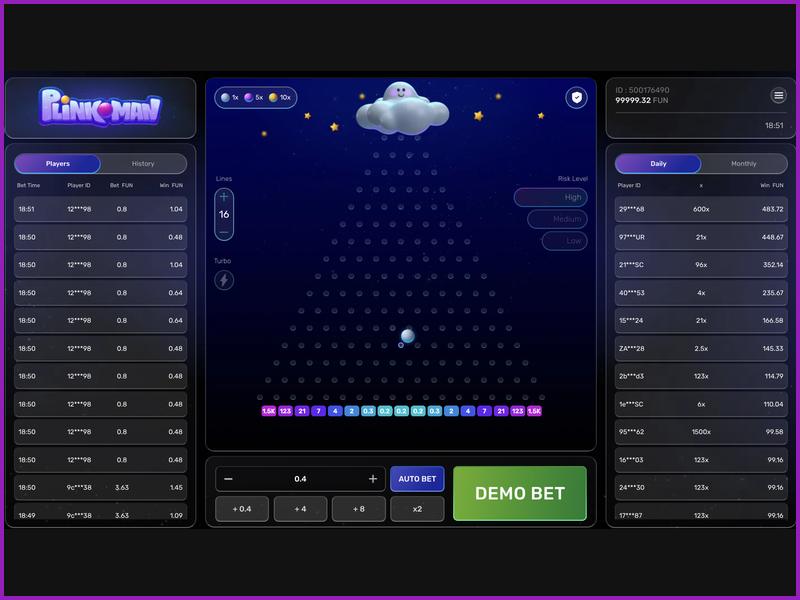
- Set Lines and risk first. The plus/minus Lines selector changes the board size; the risk buttons change its payout strip. Wait for active balls to finish before changing either setting.
- Set the virtual stake in the box beneath the board. The x2 shortcut doubles that amount; it does not double the return percentage.
- Open the menu at the top right and read the rules, including the game limits. Compare its paytable with the chosen board before pressing Demo Bet.
- Use the History tab beside Players to review your settled bets. Players lists other players’ activity; Daily and Monthly are leaderboards. Neither is your account history.
- For repeated drops, open Auto Bet, enter a bet count and use Stop to end the batch. Turbo shortens the animation; keep it off while learning how the ball multiplier and landing box combine.
If the launcher fails, reopen the demo before placing more bets. Our free Plinko simulator offers a separate practice board; its payouts and bonus rules do not reproduce Plinkoman.
Payout tables for all 8–16 lines and three risk levels
Each sequence lists every landing box from left to right, in multiples of the stake. These are the base coefficients in Plinkoman’s in-game rules. Apply the ball’s 1x, 5x or 10x multiplier separately. Normal is the middle risk setting; its rules table uses the heading Medium.
Low risk
| Lines | Multipliers (x) |
|---|---|
| 8 | 3.6, 1.3, 1.2, 1, 0.6, 1, 1.2, 1.3, 3.6 |
| 9 | 4.5, 3, 1.5, 0.9, 0.7, 0.7, 0.9, 1.5, 3, 4.5 |
| 10 | 5.5, 2.5, 1.4, 1.1, 1, 0.5, 1, 1.1, 1.4, 2.5, 5.5 |
| 11 | 7.1, 3.1, 1.9, 1.2, 1, 0.7, 0.7, 1, 1.2, 1.9, 3.1, 7.1 |
| 12 | 7.6, 3.1, 1.9, 1.3, 1.2, 0.9, 0.5, 0.9, 1.2, 1.3, 1.9, 3.1, 7.6 |
| 13 | 10, 4.2, 3, 1.9, 1.1, 0.9, 0.7, 0.7, 0.9, 1.1, 1.9, 3, 4.2, 10 |
| 14 | 12, 5.8, 3, 1.5, 1.3, 1.1, 0.9, 0.5, 0.9, 1.1, 1.3, 1.5, 3, 5.8, 12 |
| 15 | 14, 7, 3.2, 1.7, 1.4, 1.1, 1, 0.7, 0.7, 1, 1.1, 1.4, 1.7, 3.2, 7, 14 |
| 16 | 15, 7.2, 3.2, 1.5, 1.4, 1.3, 1.1, 0.9, 0.5, 0.9, 1.1, 1.3, 1.4, 1.5, 3.2, 7.2, 15 |
Normal risk
| Lines | Multipliers (x) |
|---|---|
| 8 | 17.1, 2.5, 1.1, 0.7, 0.5, 0.7, 1.1, 2.5, 17.1 |
| 9 | 23.7, 4, 1.3, 0.8, 0.6, 0.6, 0.8, 1.3, 4, 23.7 |
| 10 | 25, 6.8, 1.4, 1, 0.7, 0.6, 0.7, 1, 1.4, 6.8, 25 |
| 11 | 27, 9.5, 2.6, 1.3, 0.7, 0.6, 0.6, 0.7, 1.3, 2.6, 9.5, 27 |
| 12 | 30, 10.5, 3.5, 1.5, 0.9, 0.7, 0.6, 0.7, 0.9, 1.5, 3.5, 10.5, 30 |
| 13 | 34, 14.6, 5, 2.1, 1, 0.8, 0.6, 0.6, 0.8, 1, 2.1, 5, 14.6, 34 |
| 14 | 44, 25.7, 6.5, 2.6, 1.3, 0.8, 0.7, 0.6, 0.7, 0.8, 1.3, 2.6, 6.5, 25.7, 44 |
| 15 | 111, 44, 11, 3.9, 1.6, 0.9, 0.7, 0.6, 0.6, 0.7, 0.9, 1.6, 3.9, 11, 44, 111 |
| 16 | 350, 81, 18, 5, 2.4, 1.2, 0.7, 0.6, 0.5, 0.6, 0.7, 1.2, 2.4, 5, 18, 81, 350 |
High risk
| Lines | Multipliers (x) |
|---|---|
| 8 | 26.8, 4, 1.5, 0.3, 0.2, 0.3, 1.5, 4, 26.8 |
| 9 | 38.7, 7, 2, 0.6, 0.2, 0.2, 0.6, 2, 7, 38.7 |
| 10 | 78.3, 10.1, 3, 0.8, 0.3, 0.2, 0.3, 0.8, 3, 10.1, 78.3 |
| 11 | 138, 12.5, 4, 1.4, 0.4, 0.3, 0.3, 0.4, 1.4, 4, 12.5, 138 |
| 12 | 256, 23, 7.4, 1.8, 0.5, 0.3, 0.2, 0.3, 0.5, 1.8, 7.4, 23, 256 |
| 13 | 370, 33, 7.7, 4, 1, 0.3, 0.2, 0.2, 0.3, 1, 4, 7.7, 33, 370 |
| 14 | 600, 63, 12, 4, 1.5, 0.6, 0.3, 0.2, 0.3, 0.6, 1.5, 4, 12, 63, 600 |
| 15 | 1000, 100, 19.4, 6, 3, 0.6, 0.3, 0.2, 0.2, 0.3, 0.6, 3, 6, 19.4, 100, 1000 |
| 16 | 1500, 123, 21, 7, 4, 2, 0.3, 0.2, 0.2, 0.2, 0.3, 2, 4, 7, 21, 123, 1500 |
The central boxes matter more to a spending limit than the headline edge award. On the 16-line High board, three neighbouring centre boxes all have the same sub-stake return. Switching to Low still leaves losing boxes in the middle. Compare those central returns before choosing the higher maximum at the edges.
A displayed win can leave a net loss
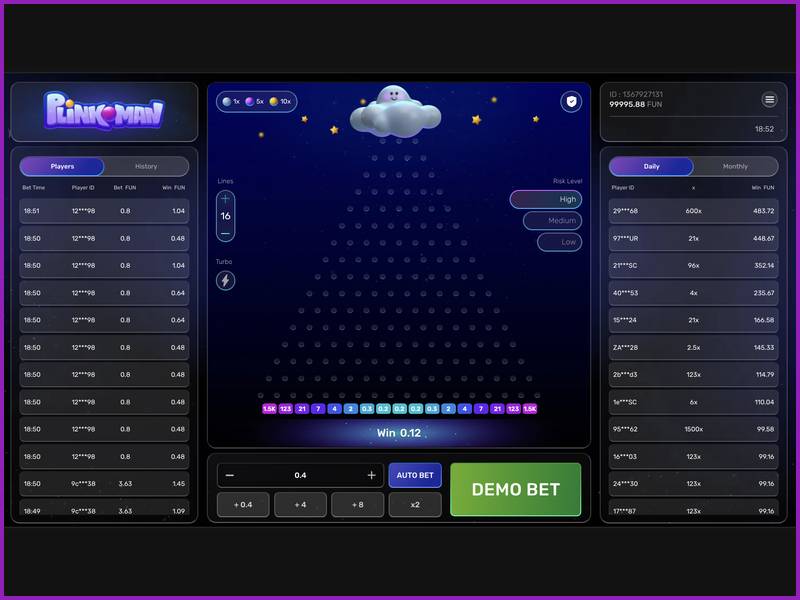
For an ordinary 1x ball, the credited return is the stake multiplied by its landing box. The stake has already been deducted. At an AUD-equivalent stake of $0.50, a 0.2x box returns $0.10 for a $0.40 loss; a 0.5x box returns $0.25 for a $0.25 loss. A 1x result breaks even, while 30x returns $15 and makes $14.50 profit.
How 5x and 10x bonus balls change a round
A bonus ball multiplies the coefficient of the box it lands in. The 5x and 10x balls appear randomly during play; changing risk or accumulating previous losses is not a bonus trigger.
The game’s rules give a concrete settlement example: a US$100 stake, a 10x ball and a 2x landing box return US$2,000, including the stake. The net profit is US$1,900. This is the rulebook example, not a recorded win. At an AUD-equivalent $0.50 stake, the same 20x result returns $10 for $9.50 profit.
| Ball | Combined multiplier | Return | Net result |
|---|---|---|---|
| 1x | 0.2x | $0.10 | −$0.40 |
| 5x | 1x | $0.50 | $0 |
| 10x | 2x | $1 | +$0.50 |
Thus a 5x bonus ball can merely recover the stake. Treating it as five extra paid drops, or adding a second ordinary-ball award to its return, gives the wrong balance calculation. History records the box coefficient, bonus coefficient, stake and win for the settled bet.
The 15,000x maximum comes from the 16-line High board’s 1,500x edge box with a 10x ball. The same board’s ordinary-ball ceiling is 1,500x and its 5x-ball ceiling is 7,500x. A $0.50 AUD-equivalent stake at 15,000x returns $7,500 before any monetary win cap. Read the game’s limits in its displayed currency; these AUD conversions are not an offer of Australian cash play.
Do not extend a session because a 5x or 10x ball seems overdue. A payout coefficient specifies the award when that event occurs; it is not the event’s probability.
FreeBet and FreeAmount promotions
FreeBet and FreeAmount are separate operator promotions with terms set by the operator. Check expiry, eligible stakes, wagering requirements and withdrawal caps before activation. Our bonus and wagering guide explains how to cost an offer.
What 97.98–98.02% RTP costs in AUD
Subtracting the published RTP endpoints from 100% gives a theoretical house edge of 1.98–2.02%. For bets governed by that RTP, expected loss = total amount wagered × house edge. Reusing returned credits increases the amount wagered even if no new deposit is made.
| Paid bets × stake | Turnover | At 97.98% RTP | At 98.02% RTP |
|---|---|---|---|
| 100 × $0.20 | $20 | $0.40 | $0.40 |
| 200 × $0.50 | $100 | $2.02 | $1.98 |
| 1,000 × $0.50 | $500 | $10.10 | $9.90 |
Rounded to the nearest cent, both endpoints cost $0.40 in the first example. The entire RTP spread changes expected loss by just $0.04 per $100 wagered. Raising turnover from $100 to $500 adds $8.08 in expected loss at the lower endpoint. Controlling the number and size of bets therefore deserves more attention than chasing that small published spread.
These expectations do not predict a session balance or cap a loss. Low risk describes the payout distribution, rather than an entitlement to 98.02% RTP. Use the stated game RTP for expected-loss calculations; adding a separate bonus allowance would overstate the return.
Choose a spending limit before using Auto Bet
A $10 allowance funds 50 bets at $0.20 each without reusing returns. Set the bet count before starting, and stop at that count or the loss allowance, whichever comes first. Stop ends new automatic bets; wait for balls already on the board to settle before reading the final balance.
Keep the stake fixed while learning the board. Raising it after a low return puts more money at risk on the next drop. Our bankroll guide covers spending and time limits.
The RNG determines the box; the animation reveals it
The landing box is determined by the game’s random number generator before the ball completes its visible journey. Tapping the screen, changing the animation speed or watching previous paths cannot steer the next ball. Turbo changes the wait for the result.
A 16-line triangle alone does not establish equal left/right probabilities at each peg. Applying a generic binomial model would assign odds to Plinkoman without its outcome distribution. A maximum payout of 15,000x also needs the 10x ball event, so counting edge boxes alone cannot give jackpot odds. Our payout-table guide explains how a game’s probabilities and awards fit together.
Australian access and our assessment
ACMA identifies online casino-style services offered to Australians as illegal services and warns that Australian regulators cannot help recover winnings withheld by illegal providers. A supplier listing, an overseas licence or an AUD balance does not establish lawful Australian real-money access. Our Interactive Gambling Act guide covers that distinction.
Our assessment: Plinkoman’s useful distinction is the 5x/10x ball modifier, while its central sub-1x boxes can reduce the balance even when the interface celebrates a win. Start with a manual demo drop, find it in History and compare its return with the stake. Then change one board setting at a time before trying Auto Bet. If gambling is becoming difficult to control, use our Australian support and blocking guide.